Smallest countries in the world: How tiny nations like Maldives, Malta and Saint Kitts and Nevis stand out globally

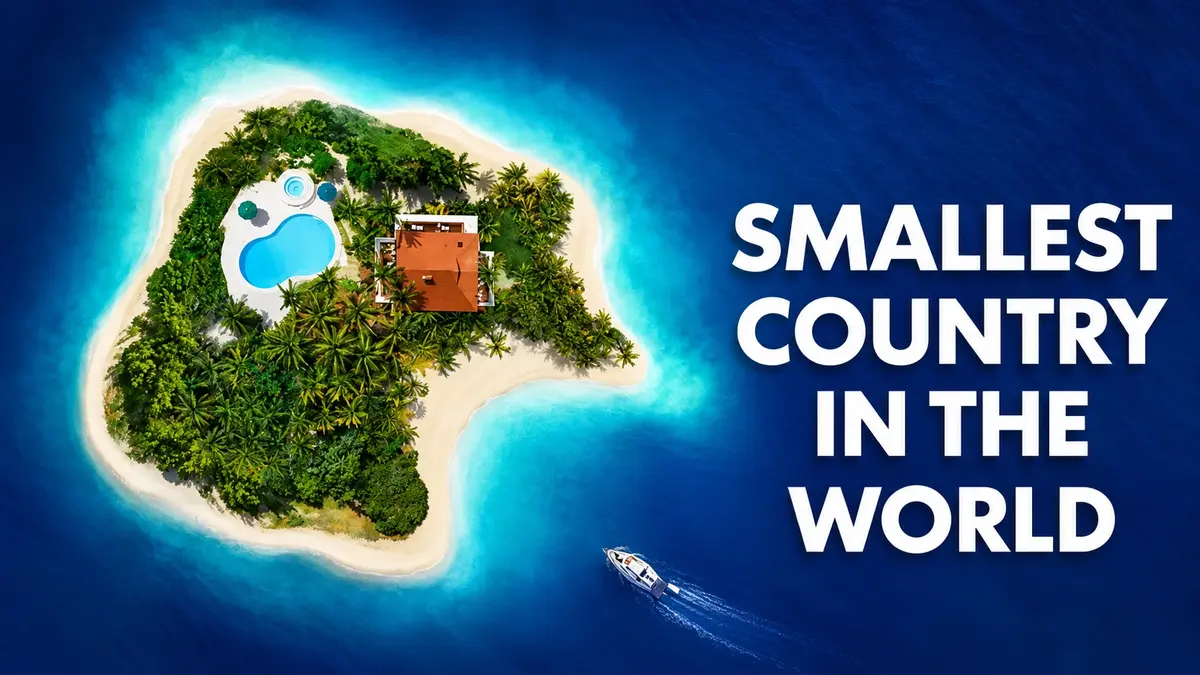
From turquoise waters in the Indian Ocean to historic islands in the Mediterranean and the Caribbean, the Smallest countries offer a different way to understand geography. Their compact size often makes them easier to explore, but their pasts are no less dramatic than those of larger nations. Many of them have been shaped by empires, trade routes, colonization, and centuries of migration. Despite their limited land area, they continue to attract travelers, historians, and researchers from across the globe.
Among these tiny nations, the Maldives, Malta, and Saint Kitts and Nevis stand out for their geography, history, and influence. Each of them tells a very different story, yet all three belong to the global list of the Smallest countries by land area.

Why the smallest countries attract so much attention
There is something naturally intriguing about very small nations. A country with just a few hundred square kilometers of land feels almost impossible when compared to giants like India, China, or the United States. But that is exactly why these countries draw so much interest. People want to know how such small territories function as sovereign nations, how they manage resources, and how they preserve their identity.
The Smallest countries also challenge common assumptions. Bigger is not always better. In many cases, these nations have strong tourism industries, distinct political systems, and highly strategic geographical positions. Their size may be small, but their importance can be much larger than expected.
That contrast is what makes them unforgettable.
Maldives: One of the most beautiful smallest countries in the world
The Maldives is one of the best-known names among the Smallest countries, and for good reason. Located in the Indian Ocean, this island nation is famous for its breathtaking beaches, clear blue waters, coral reefs, and luxury tourism. But behind its postcard-perfect image lies a country with a long and layered history.
The Maldives archipelago consists of around 1,090 islands in total. Out of these, only about 200 islands are inhabited. This already makes the country unique. Instead of one large connected landmass, it exists as a scattered chain of islands spread across the ocean. Despite this broad geographical spread, the total land area of the Maldives is only 298 square kilometers.
That number is striking.
A place made up of more than a thousand islands, yet still counted among the Smallest countries in the world by land area, shows how unusual its geography really is.
The Maldives has a population of around 393,500, which means a significant number of people live within a very limited land area. This creates a distinctive balance between nature, settlement, and development. Unlike larger countries where people can keep expanding inland, the Maldives lives with the constant reality of limited space.
A long history behind a small landmass
The Maldives may be tiny, but its history stretches far back in time. The country has been inhabited since the 5th century B.C., making it one of the historically rooted island societies in the region. Over the centuries, it came under the influence and domination of major European powers.
The Portuguese dominated the Maldives in the 16th century, followed by the Dutch in the 17th century and the British in the 19th century. This sequence reflects how strategically important the islands were, despite their small size. Colonial powers rarely focused only on large territories. They also targeted locations that mattered for trade routes, military access, and maritime movement. The Maldives fit that pattern.
Eventually, the country gained independence in 1965.
That moment changed everything.
Since then, the Maldives has grown into an internationally recognized island nation, known not only as a tourist paradise but also as one of the most talked-about Smallest countries in global geography. Its small land size has become part of its identity, but not its limitation.
Malta: A compact European island nation with deep roots
Another remarkable entry among the Smallest countries is Malta. Located in the Mediterranean Sea, Malta is an archipelago made up of seven islands. Despite being one of Europe’s tiniest nations, Malta carries extraordinary historical and cultural significance.
The total area of Malta is just 316 square kilometers, which places it very close to the Maldives in terms of size. But what makes Malta especially interesting is how much history and population are packed into this small space. Out of its seven islands, only three are inhabited: Malta, Gozo, and Comino. These are also the largest islands in the archipelago.
Malta has a population of around 446,547, which makes it one of the most densely populated countries in the world. That density is an important part of Malta’s story. It is a reminder that the Smallest countries are not always sparsely populated or isolated. Some of them are active, busy, and deeply urban in character.
Malta’s location in the Mediterranean has also made it historically important. For centuries, the island group stood at the crossroads of European, North African, and Middle Eastern influence. Even without a huge territory, Malta became a place of exchange, conflict, and political importance.
Why Malta remains globally relevant
One reason Malta continues to attract global attention is that it combines small size with strong identity. Many Smallest countries become known because of their unusual geography or tourism appeal. Malta, however, also stands out for its cultural heritage, historical architecture, and strategic position in Europe.
Its inhabited islands each contribute something distinct. Malta itself is the political and economic center. Gozo is often associated with a calmer pace of life and rural charm. Comino, though smaller and less populated, is known for its natural beauty. Together, they form a national identity that feels both compact and varied.
That is the beauty of these small nations.
They prove that a country does not need a massive land area to have complexity.
Saint Kitts and Nevis: A Caribbean gem among the smallest countries
Among the Smallest countries in the Caribbean, Saint Kitts and Nevis is one of the most interesting examples. This nation consists of two islands and has a total area of 261 square kilometers, which makes it even smaller than both the Maldives and Malta.
Saint Kitts and Nevis is located in the Caribbean and is known for its lush beauty, island culture, and colonial past. The two-island federation has a small physical footprint, but like many tiny nations, its history is shaped by far bigger powers.
The earliest inhabitants of Saint Kitts and Nevis were the Carib people, whose presence reflects the deep indigenous history of the Caribbean before European arrival. Later, Christopher Columbus explored these islands in 1498, opening the door to European control and competition.
The British occupied Saint Kitts in 1623 and Nevis in 1628. The French also settled on the islands in 1627. For about a century, the British and French fought for full control of the territory. This long struggle shows that even some of the Smallest countries were once central to colonial rivalry.
Size did not protect them from empire. In fact, it often made them more vulnerable to it.
The colonial shadow over small island nations
A striking pattern appears when looking at many of the Smallest countries: their histories are often marked by repeated foreign domination. The Maldives experienced Portuguese, Dutch, and British control. Saint Kitts and Nevis saw British and French competition. Malta too has long been influenced by larger powers because of its strategic location.
This pattern tells us something important. Small countries are often placed in geopolitically valuable locations. Their coastlines, harbors, islands, and maritime access make them highly desirable, especially in older imperial systems. While large nations were valued for land and resources, smaller island countries were often valued for their position.
That is why the history of the Smallest countries is rarely small in scale. Their territory may be limited, but the forces that shaped them were global.
What makes the smallest countries so unique today
Today, the Smallest countries remain distinctive for several reasons. First, they often develop very strong national identities because their geography is so concentrated. Citizens tend to share a closer connection to place, and in many cases, local traditions remain highly visible.
Second, these countries often depend heavily on a few major sectors such as tourism, trade, or services. The Maldives is internationally famous for luxury travel. Malta is well known for its Mediterranean culture and historical importance. Saint Kitts and Nevis benefits from Caribbean tourism and its island appeal.
Third, these countries remind the world that sovereignty is not about size alone. A nation can be tiny in area and still have its own government, culture, economy, and place in international affairs.
That is a powerful idea.
Smallest countries, biggest curiosity
The phrase Smallest countries naturally sparks curiosity because it brings together two opposite ideas: small size and national identity. A country feels like something large and powerful. But when that country can fit into a few hundred square kilometers, people begin to look closer.
And when they do, they find stories worth remembering.
They find the Maldives, where more than a thousand islands create one of the most visually stunning nations on Earth. They find Malta, where a dense and historic island society has survived and thrived in the heart of the Mediterranean. They find Saint Kitts and Nevis, where two Caribbean islands carry the memory of indigenous life, exploration, colonization, and survival.
Each of these nations is small on the map. None of them is small in meaning.
Final thoughts
The Smallest countries in the world are not footnotes in geography. They are living examples of how history, culture, and identity can flourish in the most compact spaces. Maldives, Malta, and Saint Kitts and Nevis each show that land area tells only part of a country’s story.
What matters just as much is what happened there, who lived there, who fought for it, and how it evolved over time.
That is why the smallest countries continue to fascinate people across the world. They may not dominate maps, but they stay in memory far longer than their size would suggest.
Google News |Telegram | Facebook | Instagram | Twitter | Pinterest | Linkedin